
How to Hire a COO/Director of Operations for Your eCommerce Brand
Every consumer brand runs on operations. Products need to arrive on time, customers need answers, and the team needs systems that work.
At first, the founder handles it. But as the brand grows, ops takes more and more of their time. That’s when founders come to us for a COO, a director of operations, or an operations manager.
It’s a tricky hire. Many founders hire someone a lot like themselves. And many brands great at marketing don’t have strong ops - so the best people are hard to find.
This guide covers what we’ve learned hunting them for 8- and 9-figure eCom brands.
In short, hire from about $1M a month in revenue, poach from DTC and Amazon brands ahead of you, and run a paid trial before you commit.
At a glance
| When to hire | From about $1M/month in revenue |
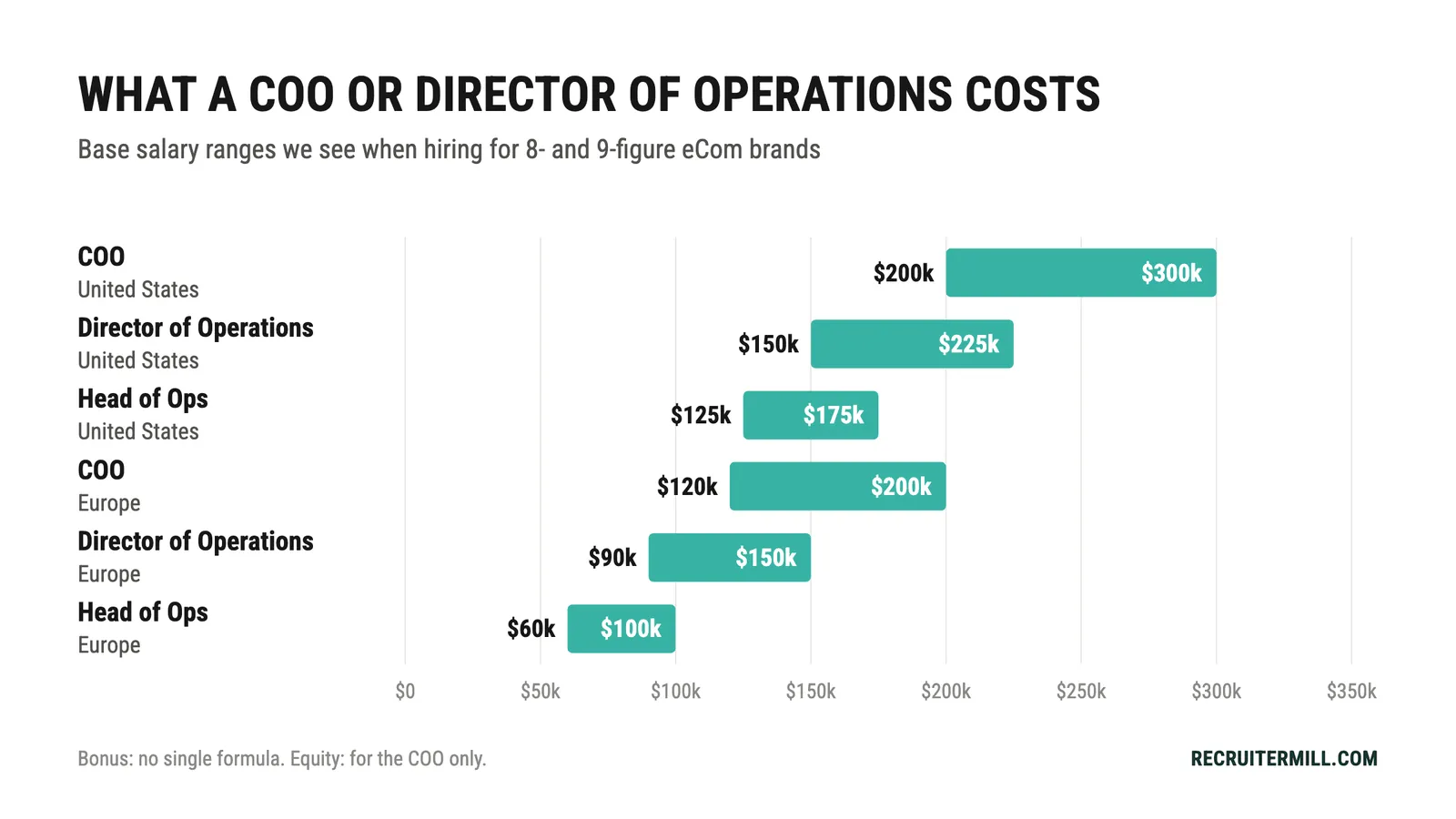
| US base salary | COO: $200-300k. Director of operations: $150-225k. Head of ops: $125-175k |
| Europe base salary | Up to 50% less than in the US |
| Bonus | No single formula. Often tied to KPIs in each ops area |
| Equity | For the COO only |
| Where to find them | DTC and Amazon brands at your scale or ahead of you |
| Response rate to expect | About 30% in the US; ~50% in Europe |
| Time to find the hire | 3 weeks or less (our target) |
| Best test | A paid trial of 1-2 weeks |
What does a COO do?
They run the side of the business that isn’t marketing. That usually covers three areas.
Day-to-day, they lead:
- Supply chain, inventory, 3PLs, etc.
- Customer support, often with its own team lead and agents
- Business operations, like SOPs and special projects across the company
The title changes with how much you hand over:
- A COO owns operations fully and keeps it growing. You treat them as an equal partner. Hire one if you want ops fully off your plate.
- An operations manager reports to you and focuses on day-to-day tasks. Hire one if you want to stay involved.
- Director of operations and head of ops sit in between. They’re catch-all titles. Some have real authority, and some mostly work on projects you assign.
When should you hire a COO?
The earliest point is about $1M a month in revenue (around $12M a year). Before that, it’s hard to afford a strong ops leader.
At that point, a head of ops can be one of your first senior hires, along with a creative strategist and maybe a growth lead.
The bigger you are, the better the talent you can attract. Strong operators want a broad scope. If they take a salaried job, they want a lot under their control.
If you have a co-founder who’s drawn to ops, you can wait much longer.
How much does a COO cost?
| Role | US | Europe |
|---|---|---|
| COO | $200-300k base | $120-200k base |
| Director of Operations | $150-225k base | $90-150k base |
| Head of Ops | $125-175k base | $60-100k base |
You can still get a really solid director of operations for about $150k in the US. In Europe, expect to pay up to 50% less.
There’s no one way to set the bonus. We’ve seen bonuses split by area, paid for hitting North Star KPIs in what matters most to the business, like supply chain, customer support, or key projects. Others are discretionary or tied to profit. It depends on what’s going on in your business.
For a COO, the offer usually includes equity on top of base and bonus.
Where to hire: US or Europe?
It depends on where you’re based and where your partners are.
If you’re in Europe, you’ll probably want someone who’s also based in Europe.
If you’re in the US and you manufacture there, with most of your partners and team nearby, you might want someone local.
But if you’re in the US and you manufacture in China or elsewhere in Asia, someone in Europe can work really well.
Step 1: Find brands to poach from
Start with brands that are ahead of you. Candidates who’ve run ops at a brand like yours bring context you can use right away.
When we look back at the ops hires who did really well, they came from DTC or Amazon brands. That’s the most relevant context.
Add both to the list of your target companies, but know their limits:
- DTC brands. Many are great at marketing but don’t have the strongest operations. So be a little careful.
- Amazon brands. On average, they’re more focused on operations and less on marketing. But they’re usually smaller, so they face less pressure to figure things out.
You can find strong people at big corporates too. They can be really strong professionals. But few of them have the context of a lean eCom brand, so you’ll have more misses. We start with scrappy brands.
To build the list, use the tools you’d use to study other brands. Ad spy tools like Foreplay show which DTC brands are scaling. Amazon research tools like SmartScout show the strongest Amazon brands.
Then do some “LinkedIn surfing”. Find a strong operator at a brand you know, see where else they’ve worked, and add those brands to your list. We show both methods in this video.
Step 2: Pitch the role
For one client, our pitch was simple. “[Brand] develops products people are dying to buy and is world-class at marketing them. Can you help scale our ops?”
Both of those things were true. And it works for three reasons:
- They’ll be in strong company. You’re telling them you’re great at what you do.
- They’ll be valued. You’re also saying you need them, because ops is where you’re not great yet.
- They get to build something. They can take ops from not built out to truly exceptional.
Our sample director of operations job description shows how we write these.
Step 3: Reach out in rounds
Reach out in rounds of 30-40 people and learn from each one.
Response rate shows how many people reply. Interview rate is the number to watch. It shows how many of the people you approached got on a call. Expect about 30% to reply in the US and about 50% in Europe, with about 15% getting on a call.
Here’s one of our searches: an operations manager for a DTC brand. One of the co-founders was running ops, and she needed to hand it over so she could focus on growing the business. They wanted someone earlier in their career, but really capable, and on their way up.
- 192 people approached, in the US and Europe
- 80 replied, a 42% response rate (normal for a mix of US and European talent)
- 36 interviewed, a 19% interview rate (our target is 15%)
- 7 presented to the founders
- 1 standout: a current operations manager who was ready for a promotion
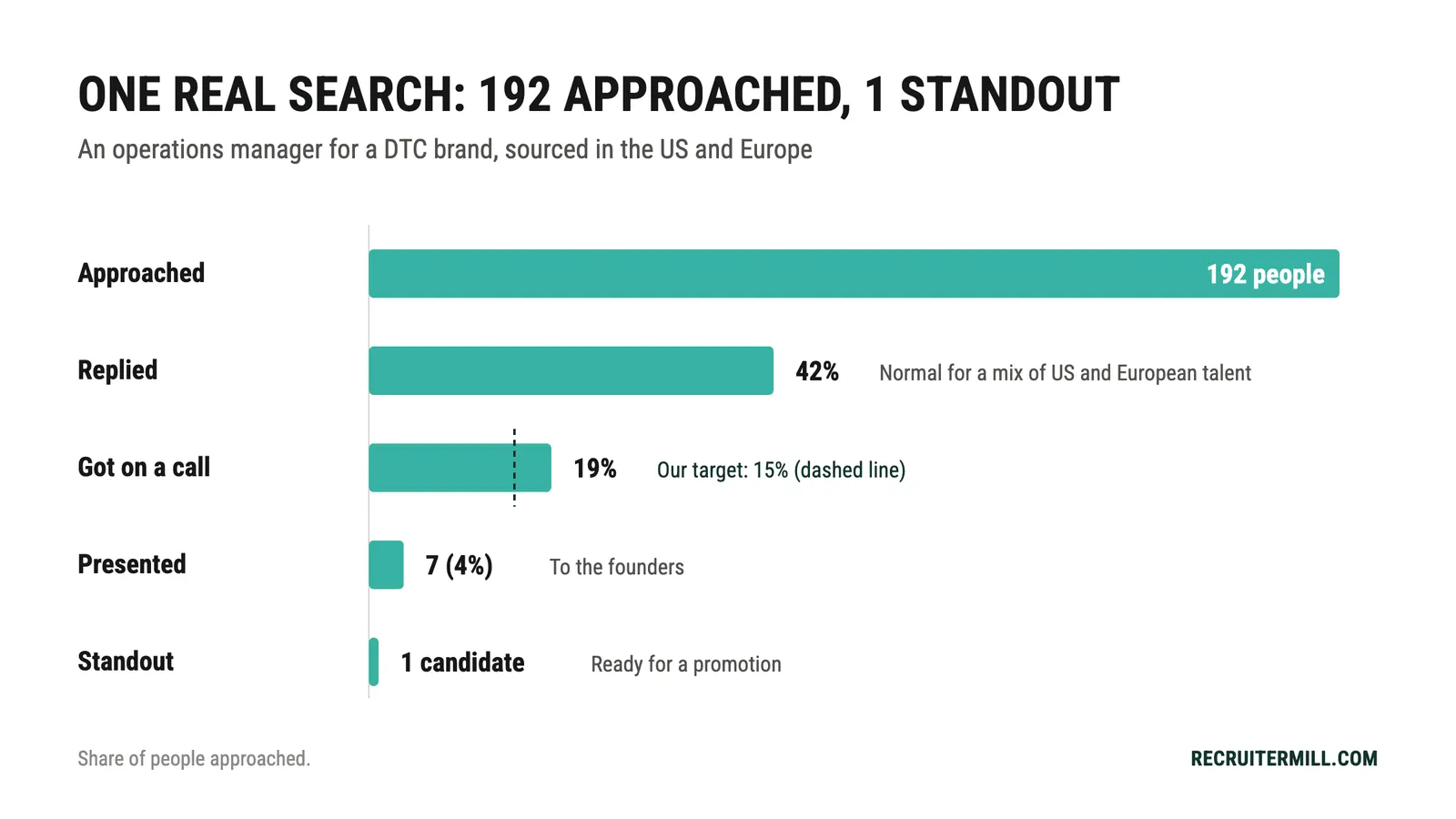
The brand was really attractive, which is why so many people got on a call.
Just as we were about to close, a childhood friend of one of the founders got in touch. They’re very close, and the founder decided to hire his friend. Here’s the full story…
If a round comes in well under these numbers, fix the candidate list or the message before you send more.
Step 4: Check the track record on the first call
Start with the usual questions:
- Why they’re interested in the role
- What they accomplished in their last role
- What their role actually was
- How the team was structured
Then give them a real situation. For example, it’s Q4, and the ads are scaling. Suddenly, your supplier tells you the shipment won’t arrive in time. What do you do in the first 30 minutes, the first 3 hours, and the following 3 days?
Keep probing with three or four follow-up questions. You want to see that they’ve been in a similar spot, know what to do, and would take the initiative to solve it.
Also check:
- Which of the three areas they’ve run: supply chain, customer support, or business operations
- Whether they’ve seen a scale larger than yours
- Whether that experience was at a DTC or Amazon brand
Step 5: Hire a “finisher”, not another you
The most common mistake is hiring someone who reminds you of yourself. They’re entrepreneurial and willing to take risks. You have really electric conversations.
But that person likely has the same weaknesses as you. They may struggle with follow-through and get bored with the more mundane parts of a project.
It helps to think of people as starters or finishers. Starters are usually founders. They come up with a brilliant idea, get it moving, and figure out the rest once there’s momentum. Finishers take things that are already moving and button them up.
If you’re a starter, you need a finisher. Many founders balance the two pretty well. Then another balanced person can make sense.
Be honest about how you work, too. We once placed an ops hire with a fast-growing multi-8-figure brand. Two days later, the founder let her go.
He’s very demanding, as he should be, and we hadn’t fully appreciated how demanding. But he made the right call for his brand. As he told us, “Before her, I didn’t realize I couldn’t work with someone like that.”
Now we screen for fit with the founder, not just the job.
Step 6: Run a paid trial
Situational questions and their track record tell you a lot. But the best test is a short paid trial of a week or two.
Give them real problems. Then watch how they solve them, how fast they react, and how communication goes.
This works well for a director of operations or an operations manager. For a COO, design the test around your situation.
To set a fair hourly rate, divide their expected yearly salary by 2,000. So a director of operations expecting $180k gets $90 an hour. Agree on the scope up front, and set a cap.
Why hire your COO with Recruiter Mill
We don’t post a job ad and wait. We headhunt.
We keep lists of the DTC and Amazon brands that are doing well. So we know where your next ops leader works today.
- Winning candidate in 3 weeks or less (our target)
- 93% 12-month success rate
- 1,000+ searches for 100+ 8- and 9-figure clients
We’re also honest about the role. “Operations” can mean almost anything, so we make sure the job is clear before the search starts.
If your brand has something special, we’d love to help.
Not ready for a call? We’ll source 10 operations leaders for your brand, free.
FAQ
Do I need a COO, a GM, or an integrator?
A COO has a defined scope: operations. A GM runs the entire business, with full authority and ownership of the P&L. An integrator, or second-in-command, is your right hand. You decide what needs to be done at a high level, and they make sure it gets done. Many founders describe their COO this way too, and that’s fine. Which one you need depends on how involved you want to stay.
Can I hire a fractional COO?
In our experience, founders almost always want this role full-time. But a fractional setup can make sense during transition periods, when you’re not ready to hire a full-time COO yet, or when there’s a particular project you want them to focus on.
Should I promote someone from my team?
Usually not. Founders want someone who has seen a larger scale than theirs. People on your team have only seen what they’ve seen at your company.