
How to Hire a CMO/Head of Growth for Your eCommerce Brand

“Growth” is a massive part of any consumer brand.
At first, that’s the founder’s job. But sooner or later, you want someone else to drive growth so you can step back. That’s when founders come to us for a growth lead, a head of growth, or a CMO.
It’s a hard hire. The people who’d do a great job are in short supply. Many run their own brands. Others are locked in by brands that know how valuable they are.
This guide covers what we’ve learned hunting them for 8- and 9-figure eCom brands.
In short, hire a growth lead from about $1M a month in revenue, poach from brands with your channel mix and ad type at your scale or a step or two ahead, and test them on real work before you commit.
At a glance
| When to hire | Growth lead: from about $1M/month in revenue. CMO: usually from 9 figures |
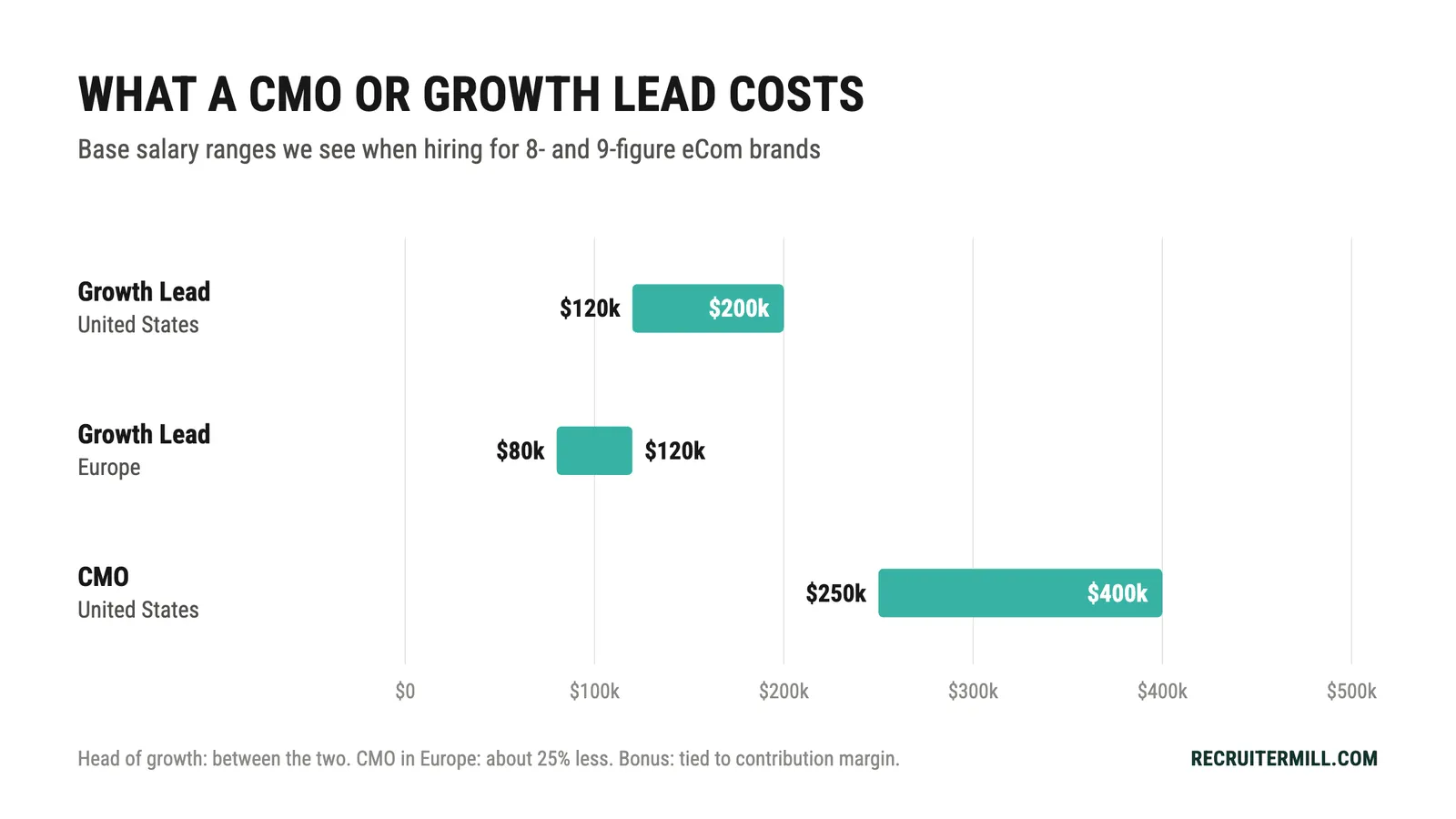
| US base salary | Growth lead: $120-200k. CMO: $250-400k |
| Europe base salary | Growth lead: $80-120k. CMO: about 25% less than in the US |
| Bonus | Tied to contribution margin, not revenue |
| Equity | Common for CMOs, possible for a head of growth, rare for growth leads |
| Where to find them | Brands with your channel mix, ad type and niche, plus agencies |
| Response rate to expect | About 30% in the US; ~50% elsewhere |
| Time to find the hire | 3 weeks or less (our target) |
| Best test | A paid audit, or a paid trial of 1-2 weeks |
What does a head of growth do?
They own growth. They maximize the channels and own the budget, the creative, and the revenue and profit targets.
Day-to-day, they lead:
- Media buying
- Creative strategy
- CRO and post-click, including offers
- Retention (many still focus on acquisition, but that line is fading)
They don’t own product or operations. Those belong to the founder or a GM.
The title changes with the size of the job:
- A growth lead is a mini CMO. They understand every growth function well enough to work across all of them. They may manage a few people, freelancers, or agencies. They often report to a founder who’s effectively the real CMO.
- A CMO is an executive with directors or VPs under them, one per function.
- A head of growth sits in between. It’s also a catch-all title, used for anyone driving growth at a senior level.
When should you hire a head of growth?
Start with a growth lead once you’re at about $1M a month in revenue (around $12M a year).
By then, you have the budget for a strong hire and the momentum to give them something to scale. It works best when you stay involved.
Bigger brands attract stronger people. But we’ve seen brands in the low 8 figures land someone who truly moves the needle.
A CMO usually makes sense from 9 figures in revenue. Below that, it’s rare.
Even at 9 figures, a growth lead can be the better hire. That’s the case when the founder is a strong marketer and is, in effect, the brand’s CMO.
How much does a head of growth cost?
| Role | US | Europe |
|---|---|---|
| Growth Lead | $120-200k base | $80-120k base |
| Head of Growth | Between the two | Between the two |
| CMO | $250-400k base | About 25% less than in the US |
Tie the bonus to contribution margin, not revenue. Revenue is easy to fake. Anyone can buy more of it by spending more on ads at a loss. Contribution margin shows what’s left after ad spend and product costs, so it rewards growth that makes you money.
Equity is common for CMOs. It can be part of the offer for a head of growth. It’s rare for growth leads.
Where to hire: US or Europe?
For senior roles like CMO, there’s more talent in the US.
For growth leads, there are strong people on both sides of the Atlantic. eCommerce has killers everywhere, and many of them are very hungry.
European candidates have an edge. In the US, they might have hundreds of comparable brands to choose from. In Europe, it could be ten or fewer. So they’re much more open to a relevant opportunity.
Knowing your customer in their gut matters less here than for a creative strategist. A growth leader can learn your customer on the job.
Almost everyone in this role works remotely now. Time-zone overlap still helps, and many brands like their people close by.
But brands that meet strong European candidates often decide that a 6-7 hour difference is easy to work with.
Step 1: Find brands to poach from
Start with a list of brands like yours. Candidates who’ve done this job at a similar brand are much more likely to do well for you.
Match on:
- Channel mix. If Meta drives your growth, look for brands that are strong on Meta.
- Ad type and funnel. UGC, mini-VSLs, VSLs further down the funnel, quiz funnels, advertorials. Shared context helps a lot.
- Amazon, TikTok Shop, and retail, if they matter to you. A head of growth at a DTC brand often works mostly on Meta, so be clear about this.
- Niche. Beauty brands do better with people from beauty or a related niche, like supplements.
- How direct-response the brand is. Roughly match your style.
Then look at scale. Hire from a brand at your scale or a step or two ahead of you. Think about where you want to be in 18 months, and whose experience would carry over best.
For a growth lead, you can even hire from a brand doing less than you, or from an agency. Add performance agencies to the list of your target companies. Their people often want their first big role at a brand, so you can land top talent who haven’t had their shot yet.
Be careful with much bigger brands. Those people are used to big teams and budgets. Even if they were brilliant there, they may lack the skills a lean brand needs.
To build the list, use the ad spy tools you already use for ads, like Foreplay. Then do some “LinkedIn surfing”. Find a strong person at a brand you know, see where else they’ve worked, and add those brands to your list. We show both methods in this video.
Step 2: Pitch the role
Top growth leaders get plenty of offers. They’re more likely to reply when you have:
- A strong growth trajectory. They want their work to show up in results.
- Recognition. Brands that are well known in eCom get more replies. People have seen their ads and liked them. When they Google the brand, it looks good.
- A product that truly helps people. Ask yourself, “Would I be upset if my mom bought this?” A brand built on wild health claims gets far fewer replies than one with a product that actually makes lives better.
- Retail presence. Being on shelves makes a brand look more legitimate.
Timing matters too. When a company gets acquired, its people face a lot of unknowns, so they’re more open to hearing from a recruiter.
Our sample head of growth job description shows how we write these.
Step 3: Reach out in rounds
Reach out in rounds of 30-40 people and learn from each one.
Response rate shows how many people reply. Interview rate is the number to watch. It shows how many of the people you approached got on a call. For this role, expect about 30% to reply in the US and closer to 50% elsewhere, with about 15% getting on a call.
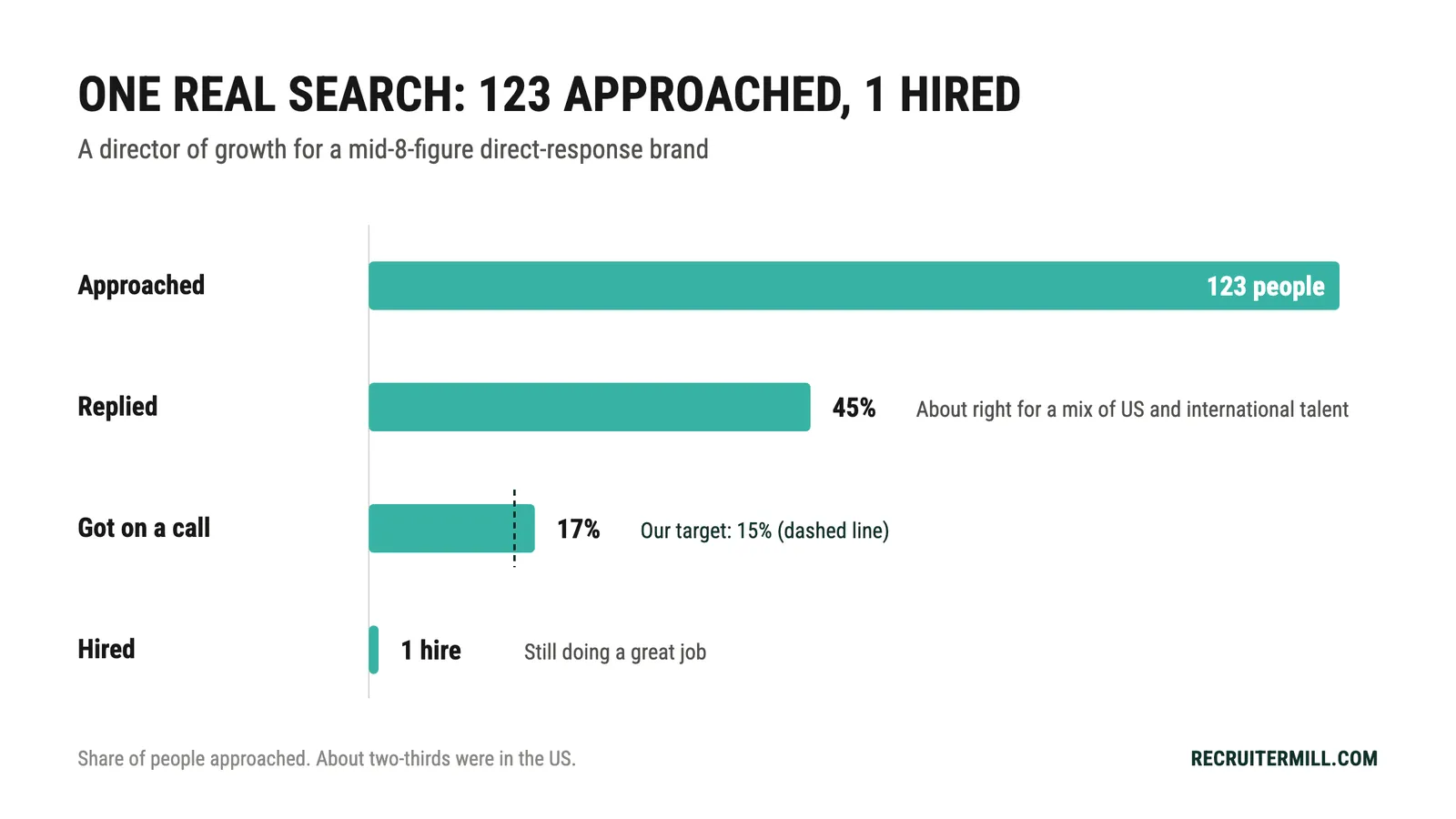
Here’s one of our searches: a director of growth for a mid-8-figure direct-response brand. It was growing into an established brand with some retail presence.
- 123 people approached, about two-thirds in the US
- 56 replied, a 45% response rate (about right for a mix of US and international talent)
- 21 interviewed, a 17% interview rate (our target is 15%)
- 5 candidates presented to the client, and most got a follow-up call
- 2 strong finalists, and 1 hire who’s still doing a great job
One finalist ghosted us, so plan for more than one strong candidate at the end.
If a round comes in well under these numbers, fix the candidate list or the message before you send more.
Step 4: Check the track record on the first call
If you sourced the candidate from a relevant brand, you don’t need much screening before the call. The call is where you check the track record.
Ask:
- What made them interested in their current role
- Which KPIs are their North Star
- What they did to move those KPIs, with each initiative explained in detail
Look for nuance. Strong candidates can walk you through every initiative. Each one makes sense, would move the needle, and connects logically to the result.
Then check:
- Range. Have they worked across media buying, creative strategy, CRO, and retention? Some areas will be stronger. Find out which, and decide if the weaker ones are fine for you.
- Scale. Have they succeeded at your scale or higher? Working at scale adds pressure and sharpens thinking.
Don’t rule someone out just because they haven’t worked at your scale. Look for signs they’d excel if given the chance.
Step 5: Don’t hire the biggest name
A few years ago, we found a candidate who led marketing at the most successful eCom company in their country. We were thrilled, and so was the candidate.
But the two companies worked in very different ways. A few months in, both sides agreed it wasn’t the right fit.
It’s an easy mistake to make. You see the famous brand and a sharp person. But the business model and the context are different. So it doesn’t work out.
We haven’t made that mistake since. Hire for the closest match to your context, not the most famous logo.
Step 6: Test them on real work
This hire matters too much to get wrong. If it doesn’t feel great, don’t make the hire.
Think of it like marriage. You’d date before you got married. A test or a trial is that dating period.
For a growth lead or head of growth, you have two options.
The first is a paid test assignment. Ask for one or both of these:
- An audit of your account
- A plan to solve a real problem your brand faces right now, and maybe some early work on it
Most people will use AI, and they should. Look for what they add beyond it, like insights from their own experience and proof they know what to look at.
The second option is even better: a short paid trial. For a week or two, they work with you a few hours a day, up to four if they’re available.
Don’t expect big results in that time. You’re testing how you work together. How do they respond? How does communication go? Can you see them thriving on your team for years?
Explain that it protects candidates too. Nobody wants to leave a good job and be disappointed a few months later. Most like this approach.
To set a fair hourly rate, divide their expected yearly salary by 2,000. So a growth lead expecting $160k gets $80 an hour. Agree on the scope up front, and set a cap.
For a CMO, a trial is harder. They’d need to really get to know your team and your business first. So plan more conversations instead. Have them talk to several people on the team. If you’re hiring remotely, fly them in to meet you in person.
In one recent CMO-level search, the candidate did a longer audit and presented it to the team as a paid consulting project.
Why hire your head of growth with Recruiter Mill
We don’t post a job ad and wait. We headhunt.
We keep lists of nearly every DTC brand that’s doing well, and the agencies that serve them. So we know where your next growth leader works today.
- Winning candidate in 3 weeks or less (our target)
- 93% 12-month success rate
- 1,000+ searches for 100+ 8- and 9-figure clients
We’re also honest about the job. We’ve turned down head of growth searches where the founder really wanted a GM without the title, pay, or authority. Getting the role right comes before the search.
If your brand has something special, we’d love to help.
Not ready for a call? We’ll source 10 growth leaders for your brand, free.
FAQ
Do I need a head of growth or a general manager?
A head of growth owns marketing and growth. A GM also owns product, finances, operations, and hiring across the company. In effect, a GM is the CEO. If you expect someone else to grow the whole business while you step back, you need a GM, president, or CMO with that scope. Then ask what you’ll bring yourself, such as funding, a unique vision, or connections that open doors.
Which title gets the best candidates to reply?
The title matters less than the seniority. The most senior people are the hardest to reach, so a CMO search is the toughest. A growth lead is still not an easy hire, but it’s the easiest of the three.