
How to Hire a CEO/General Manager for Your eCommerce Company
A CEO or GM runs your entire business. Growth, product, operations, and the team all go through them.
Founders come to us for this role at two moments. When they’re launching a new brand, vertical, or channel. Or when they’ve decided it’s time to step back from running the company.
It’s the hardest hire to get right. The best candidates are in great situations, and they don’t need to reply.
This guide covers what we’ve learned hunting them for 8- and 9-figure eCom companies.
In short, hire one when you have real traction or a funded new venture, poach from companies one or two steps ahead of you, and give them the authority to actually run the business.
At a glance
| When to hire | Existing consumer brand: from 9 figures. B2B company: from 8 figures. New brand, vertical, or channel: once capital and runway are guaranteed. |
| US base salary | $300-500k |
| Europe base salary | About 30% less than in the US |
| Bonus | Custom. Tied to profit, revenue, or an exit. Usually 30-100% of the base. |
| Equity | Expected. Usually single digits; low double digits if they build from scratch |
| Where to find them | Companies one or two steps ahead of you that combine the 2-3 competencies you need most |
| Response rate to expect | 15-25% in the US; 25-40% in Europe |
| Time to find the hire | About 6 weeks |
| Best test | Many follow-up conversations, including their plan for the first 90 days |
What does a CEO or GM do?
They own the whole business and have full authority to steer it.
Day-to-day, they lead:
- Growth
- Product
- Operations
- The senior team: usually heads of growth, ops, finance, and product
Vision is a team effort between the founder and the CEO/GM. The founder usually brings the capital and often opens doors with connections.
After the hire, the founder effectively becomes chairman of the board, even if there’s no formal board. You’ll probably talk to your CEO or GM once a week, or even less if you want to step back further.
What about the title: CEO, GM, or president? In practice, there’s no real difference. The titles are used pretty interchangeably, and candidates have their own preferences. So don’t stress it too much.
As a rule of thumb, choose CEO if there will be other executives, a real C-suite, on the team. Choose GM at an earlier stage, or for a new brand or vertical.
When should you hire a CEO or GM?
There are two good moments.
The first is a fresh start: a new brand, a new vertical, or a big channel expansion. For example, an Amazon-only business going omnichannel. This is really attractive to the best candidates. They get a clean slate and can build from the ground up.
The second is more traditional. The founder realizes it’s time to move on. Maybe running a company isn’t where their interest lies anymore. That’s a perfectly fine moment to hire, too.
Either way, don’t hire too early. An outside leader needs significant traction to work with.
If you’re hiring into an existing consumer brand, we’d struggle to see it before 9 figures in revenue. For a B2B company, that’d be before 8 figures.
If they’re building something new, that’s fine. But they should still have guaranteed capital and a set runway.
How much does a CEO or GM cost?
| Role | US | Europe |
|---|---|---|
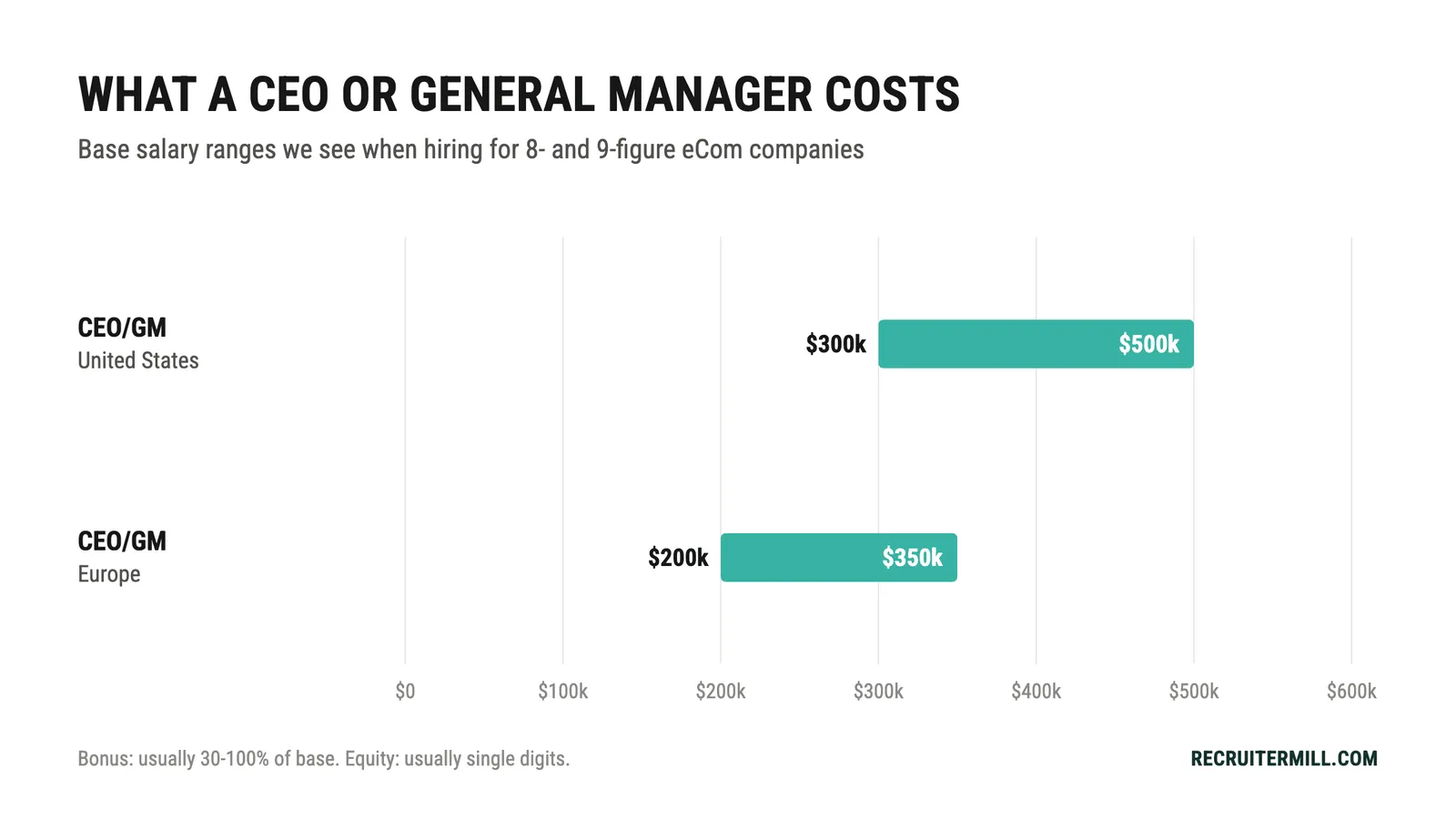
| CEO/GM | $300-500k base | $200-350k base |
In Europe, expect about a 30% discount. Pay can go higher for a really established brand.
The bonus is a very custom decision. Profit, revenue, and an exit can all come into play. Be very careful here, because the bonus is how you align their incentives with yours. It’s usually 30-100% of the base salary.
Equity is unavoidable for this role. It’s usually in the single digits. If they’re building something entirely from the ground up, it can reach the low double digits.
Where to hire: US or Europe?
By default, we’d hire in the US, because that’s where the best talent pool is, especially for the senior people they’ll hire under them.
If your company is already in Europe, or Europe is your main market, hiring there makes sense.
They don’t need to be in your time zone. You’ll talk about once a week, so a different time zone shouldn’t be a problem.
Remote or on-site is up to you. We’re big believers in remote, because it gives you a much bigger talent pool. But on-site is fine too, if that’s how you want to build your company.
Step 1: Find companies to poach from
Start with companies one or two steps ahead of you. Look for ones that have built the kind of organization you admire and want to build yourself.
First, figure out the two or three things that are really critical to your growth. Then look for someone who has combined them, or a company that has.
Strength in DTC, in product development, or in your particular vertical is a huge bonus. But it’s not a must.
At this level, most strong candidates have already run a business a step ahead of yours. This is their second time around, and they come in with the lessons learned.
Career operators are your primary targets. There’s a certain type of person who really enjoys running a company at a certain scale.
Former founders can work too. The skill set can translate, though we haven’t placed someone with that profile yet.
Be really careful with big corporates like Procter & Gamble or L’Oréal. Their orgs are set up entirely differently. Say social commerce is a must-have for your hire. How much is someone from a big corporate likely to know about it?
To build the list, do some “LinkedIn surfing”. Find a strong leader at a company you admire, see where else they’ve worked, and add those companies to your list. We show how in this video.
Step 2: Pitch the role
This can be one of the most desirable roles there is. So the first question is whether your setup is attractive to a builder.
For one search, we got leaders from Huel, Orgain, and Jimmy Joy interested within 3 weeks, and they all took follow-up calls with the client. The role was to run a new meal-replacement line, and the offer was really attractive.
What makes the best people reply:
- Real authority. They need a green light to build.
- A clear, exciting mission for the next 4-6 years. It shows them what they’d be building and why it’s worth leaving a great situation.
- Equity. It’s table stakes, so it won’t win them over on its own.
What scares them off is a lack of clarity. “We need a CEO to run our business, but we don’t know what to do.” They might figure it out for you, but it’s a much longer process. So work out what you’re looking for first.
Remember, it’s a great deal for you, too. Even if you give up 10% of your company, someone who’s done it before builds the rest for you.
Our sample general manager job description shows how we write these.
Step 3: Reach out in rounds
Reach out in rounds of 30-40 people and learn from each one.
Response rate shows how many people reply. Interview rate is the number to watch. It shows how many of the people you approached got on a call.
Expect both to run lower than for other roles. Many of these people are in great situations, so they have no need to respond. A 25% response rate is high for a GM search. An interview rate around 10% is healthy, compared with our usual 15%.
Here’s one of our GM searches, for an ambitious founder who wanted to rebuild one of his brands:
- 232 people approached
- 61 replied, a 26% response rate
- 20 interviewed, an 8.6% interview rate
- 10 presented to the founder
- 1 hire, from outside the brand’s niche
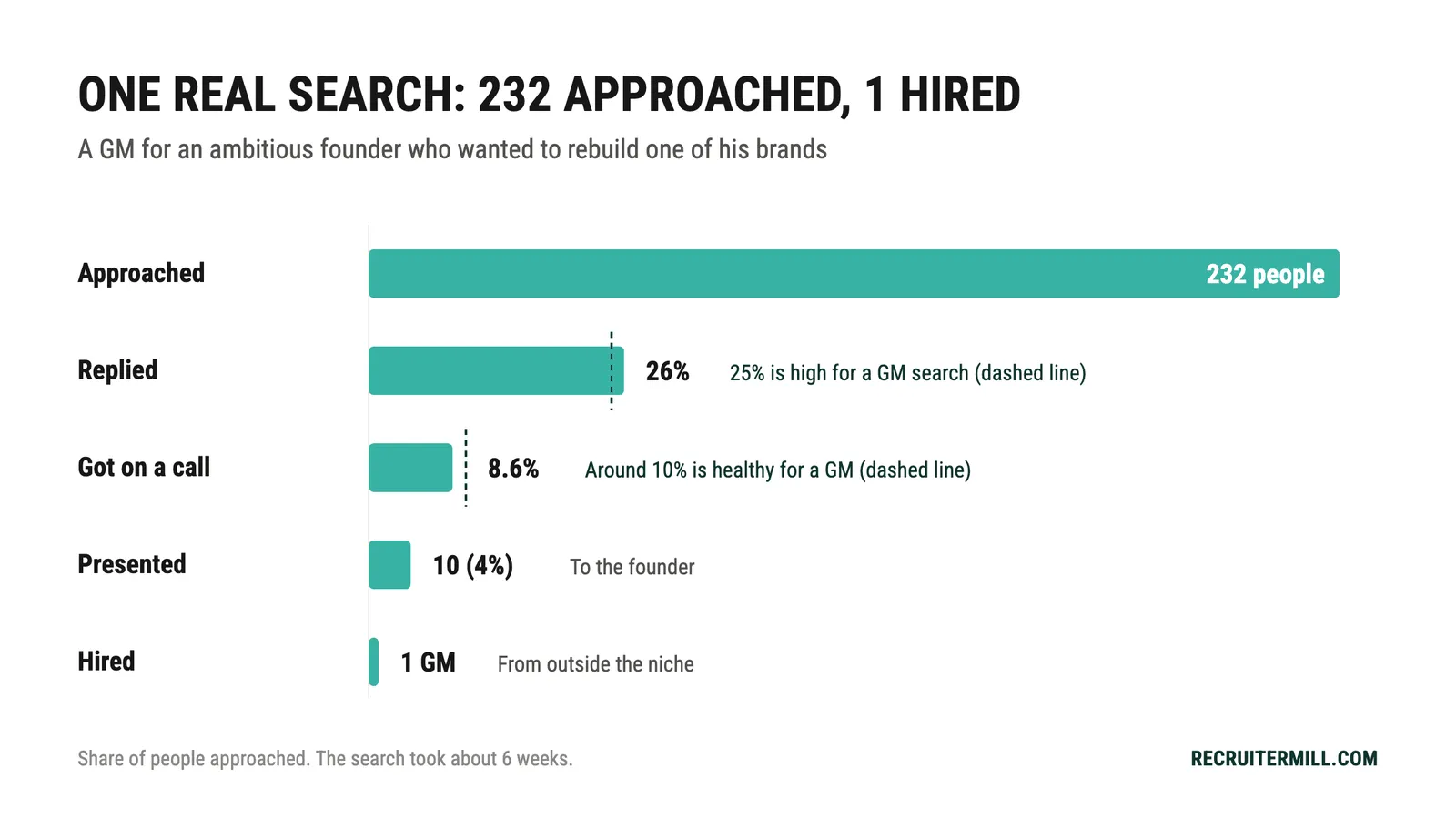
It also took longer than usual. For a director role, we typically find the hire in 3 weeks or less. This search took closer to 6 weeks.
That’s because the founder had many follow-up conversations. It’s a really important role, and you learn a lot from the people you interview. So it pays to talk to many of them and build your understanding of the role.
If a round comes in well under these numbers, fix the candidate list or the message before you send more.
Step 4: Check the track record before the first call
Some of the checks can happen on their LinkedIn profile. Others need a screening call.
Before the call, check:
- Whether they have the two or three things you need most. In that search, the founder knew exactly which three he wanted.
- The companies they’ve worked for, and whether those were in your niche
- Whether they’ve worked at the scale you’re aiming for
On the screening call, check:
- What they personally did. We approached brands in the niche that had done well on the channels the founder cared about. But sometimes someone else ran that channel, or they had a very different approach than the one our client needed.
- How fluently they explain their business and their job changes
- How fast they grew the company
Speed is the big one. That founder wanted to grow very fast over four years. A candidate who took a brand to 9 figures over a decade is very healthy. But someone who did it in three years has taken a different approach. So they were the ones he was most interested in.
Step 5: Don’t be close-minded about niches
In the search above, our job was to find someone from the client’s vertical.
We ended up going with someone from outside that niche. But they had worked on many similar brands across different niches.
They turned out to be an outstanding GM and have done exceedingly well in the first six months.
Ideally, your hire will already have worked in your niche. But someone who’s succeeded across niches can be just as strong. So don’t rule them out.
Step 6: Replace the test with real conversations
We didn’t use a paid test for this search. Instead, the founder and the top candidates had many follow-up conversations. They met in person and kept discussing the business from different angles.
The higher the role, the more you have to use your own judgment and trust it. There’s no single formula for vetting a CEO or GM.
One thing that helps is asking them to build their plan for the first 90 days during those conversations. In that search, the plan was essentially to rebuild the company. The GM then executed on it after he joined the company.
After the hire
Let your new CEO or GM hire their own team.
Founders are often eager to get started and try to hire, say, a CMO before the GM is in place. But it’s essentially impossible.
A CMO is a hard hire to begin with. And without knowing who the GM will be, it’s really hard for a CMO to sign up. The GM might also have a different vision, which would change who you need.
Why hire your CEO or GM with Recruiter Mill
We don’t post a job ad and wait. We headhunt.
We start with the two or three things your growth depends on, then go after the companies whose leaders have combined them.
- Leaders from companies like Huel, Orgain, and Jimmy Joy on one shortlist within 3 weeks
- 93% 12-month success rate
- 1,000+ searches for 100+ 8- and 9-figure clients
We’re also honest about the role. Before the search starts, we make sure it’s an actual GM job, not just a GM title.
If your brand has something special, we’d love to help.
Not ready for a call? We’ll source 10 CEO and GM candidates for your brand, free.
FAQ
Do I need a GM or a head of growth?
If you want to stay involved and keep owning the business, you need a head of growth, not a GM. A GM has to call the shots, at least over a few months at a time.
That’s a perfectly fine choice, but be clear about what you’ll keep owning and where you need help. If you want to stay CEO yourself, a chief of staff might be the hire.
Can my COO step up into the GM role?
It’s not impossible, but they’re different roles. A COO is the integrator to someone else’s visionary.
A GM has to operate like a founder, even without the title. So a really good COO won’t automatically make a good GM.
Can I hire a CEO and a GM together?
That makes no sense. It’s effectively the same role, so you’d have two people doing one job.