
How to Hire a Head of Retention for Your eCommerce Brand

Every brand pays to win a customer. Retention decides how much that customer is worth. It’s what turns a churn-and-burn operation into a real brand.
Once subscriptions or repeat orders become a big part of your revenue, someone has to own that program. That’s when founders come to us for a head of retention.
It’s a hard hire. The brightest minds in eCom typically go to acquisition, because it drives clear immediate impact. So true retention leaders are rare.
And many founders come from acquisition themselves. So it’s hard for them to tell who really knows retention.
This guide covers what we’ve learned hunting them for 8- and 9-figure eCom brands.
In short, hire once your subscription program is a meaningful part of revenue, poach from eCom subscription brands, and grill every candidate on the moves they made and why.
At a glance
| When to hire | Once subscriptions or repeat purchases are a meaningful part of your revenue |
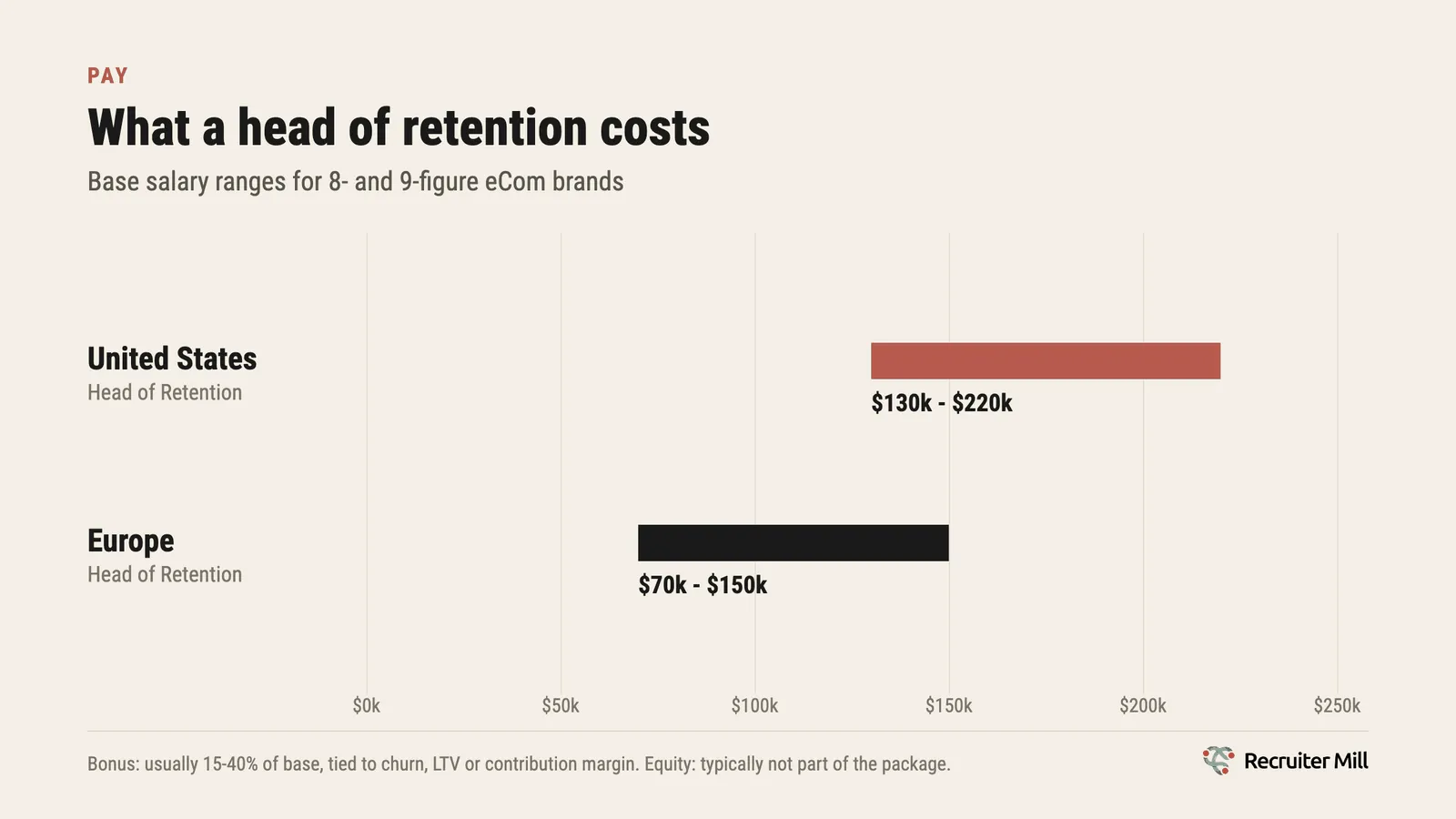
| US base salary | $130-220k |
| Europe base salary | $70-150k |
| Bonus | Usually 15-40% of the base, tied to churn, LTV, or contribution margin |
| Equity | Typically not part of the package |
| Where to find them | eCom subscription brands and retention agencies |
| Response rate to expect | About 30% in the US; ~50% in Europe |
| Time to find the hire | About 2 weeks in our last European search; about 10 weeks in our last US search |
| Best test | A paid flow audit or a trial period, then a 90-day plan |
What does a head of retention do?
A head of retention gets the maximum value out of your subscribers.
That’s broader than a head of email or a CRM lead. They own a channel, such as email or SMS, and get the most out of it. A head of retention owns the entire program, and the channels are tools inside it.
Day-to-day, they own:
- What happens on the first rebill
- What happens when someone tries to cancel, and when a save makes sense and when it doesn’t
- How to make the subscription a better value for the customer, so fewer people cancel
- Email and SMS flows and one-off campaigns
- Retention copy
At a lean brand, where everyone pulls their weight, they won’t just manage. They’ll do the work too. Some run the program alone. Others lead a team or use shared resources. It depends on who you already have.
When should you hire a head of retention?
There’s no strict revenue level.
It usually becomes clear to founders on its own. Your subscription program is driving a ton of revenue, often more than what you acquire month to month. Once subscriptions are a meaningful part of the revenue pie, you want someone owning that function.
This role fits best at subscription brands, or brands where another purchase makes sense.
If you sell durables, where people rarely buy the same thing twice, you need other product categories to offer to the customers. Otherwise, there isn’t much for a head of retention to work with.
How much does a head of retention cost?
| Role | US | Europe |
|---|---|---|
| Head of Retention | $130-220k base | $70-150k base |
The bonus is usually 15-40% of the base salary. It can go higher when retention is a really massive part of the job.
Don’t tie it to email or SMS revenue. Tie it to churn, LTV, or the contribution margin of your subscription program. That’s what the role is really there to move.
Equity is typically not part of the package.
Where to hire: US or Europe?
This is a rare skill set and an advanced hire.
The more advanced brands are generally in the US. That’s where they’ve learned retention, so you’ll usually find the best talent there.
Europe also has some very strong people. And as retention becomes more important, more talented people are moving into it on both sides of the Atlantic.
Step 1: Find brands to poach from
Start with DTC brands, especially those with a subscription element. That’s the most relevant context.
They don’t always have the strongest people, though. So add retention agencies to the list of your target companies.
Should you hire from an agency? For a channel role, such as head of email, often yes. Most of the best email talent is at agencies. But a retention program is such a holistic part of the business that it’s typically owned in-house. So for a head of retention, look for people who’ve owned retention in-house.
To find more brands that take retention seriously, use BuiltWith. It shows which brands run subscription apps like Recharge and Loop.
We’ve also looked outside eCom. Telecom and gambling companies live and die by retention, so on average, their people are sharper. But they don’t have the eCom context.
In one search, we tried telehealth first, since a lot of the mechanics are the same. Not much there. Then we found someone phenomenal in gambling. The founder passed: a great operator, but too far from what they do. They wanted eCom experience. It’s what we eventually got him.
Step 2: Pitch the role
A talented retention leader looks for two things:
- The rest of the company is humming along. They don’t want to join a business that’s broken somewhere else.
- Their impact will be felt. Even more than the first point, they want to make a real difference.
So a classic hook is: “We’ve already cracked acquisition. Now retention is the biggest opportunity for our company.” For a lot of the brands we work with, that’s a natural pitch.
Two things scare them off.
The first is a brand that expects miracles. Retention can make a big difference. But it’s more about stacking 1% improvements than a few grand changes that save the business.
The second is a product that doesn’t do what it says on the tin. Customers won’t stay, and the head of retention will be blamed for it.
Our sample head of retention job description shows how we write these.
Step 3: Reach out in rounds
Reach out in rounds of 30-40 people and learn from each one.
Response rate shows how many people reply. Interview rate is the number to watch. It shows how many of the people you approached got on a call. As a rule of thumb, expect about 30% to reply in the US and 50% in Europe, and about 15% to book a call.
Here’s our last US head of retention search, for a 9-figure eCom brand with a large subscriber base.
- 371 people approached
- 169 replied, a 46% response rate
- 83 interviewed, a 22% interview rate
- 16 presented to the client
- 1 hire
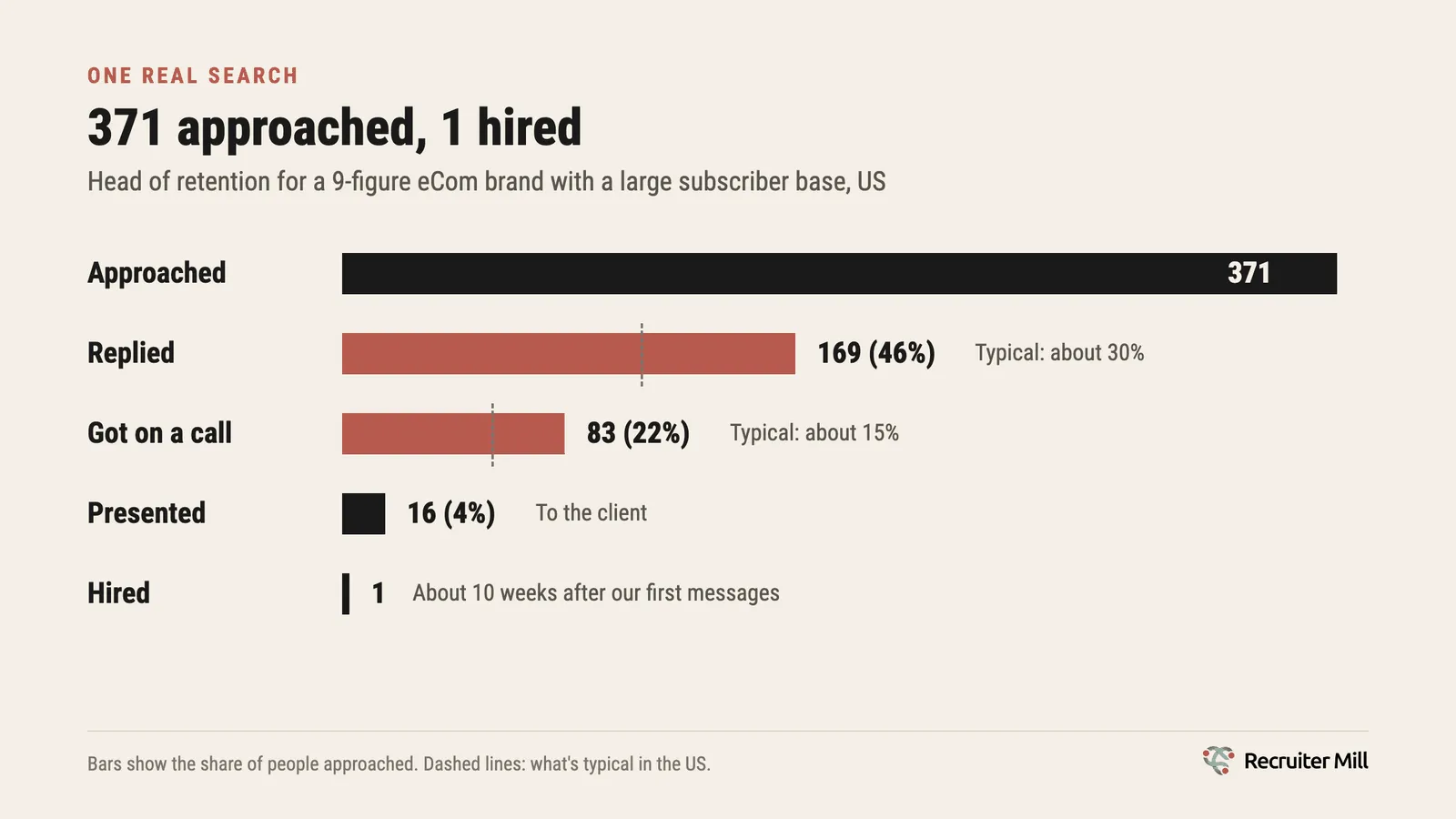
Those are strong numbers. People wanted in. And that was the trap. Most of them weren’t good enough (more in Step 5), so we approached about three times as many people as in a normal search. The hire came about 10 weeks after our first messages.
A few weeks earlier, we’d run the same search in Europe and found someone awesome in about two weeks. So retention searches can go either way.
If a round comes in well under these numbers, fix the candidate list or the message before you send more. But if you know the talent exists, people are still replying, and your offer is strong, don’t give up. Keep going until you find the one person who can actually do it.
Step 4: Check the track record on the first call
A strong candidate should be able to explain:
- Email and SMS share of revenue
- Flow revenue vs campaign revenue
- Repeat purchase rate
- Subscription churn
- LTV
Then look at their actual work. You don’t need to do this for every candidate. Once you’re serious about someone, ask them to walk you through their flows and campaigns on the screening call or the follow-up call.
Step 5: Look for depth, not a big brand name
Retention is an underdeveloped function in eCom, but a really impactful one.
So don’t rely on someone having worked for a big brand. That alone won’t give you the results.
In the search above, we kept getting people on calls with great resumes and all the right wins. Then they’d talk about those wins, and there was no depth.
“We decreased churn by 50%.”
Cool, what did you do?
“We ran some initiatives.”
Okay, what were your considerations?
We had to pull it out of them, instead of them just telling us.
A great candidate can go 10, 15, 20 minutes on a single problem. They walk you through every consideration and tradeoff: which cohort was churning and why, what they tested, and how they moved rebill rates and AOV.
So really grill these people. Did they make thought-out moves? Or did they follow the same playbook as everyone else, without thinking much deeper? That’s the biggest thing to look out for.
Step 6: Give a paid test assignment
A flow audit is a good test. Give them access to your current flows and ask what they’d change and why.
A paid trial period with your brand works too. It shows you how they work with your real data and your team.
Then ask for a plan for the first 90 days.
To set a fair hourly rate, divide their expected yearly salary by 2,000. So a head of retention expecting $180k gets $90 an hour. Agree on the scope up front, and set a cap.
After the hire
In the first 90 days, they execute on the plan they created themselves.
Why hire your head of retention with Recruiter Mill
We don’t post a job ad and wait. We headhunt.
We start with the eCom subscription brands and retention agencies that are doing it well. Then we go after the people who built those programs.
- A 46% response rate and a 22% interview rate in our last US head of retention search
- 93% 12-month success rate
- 1,000+ searches for 100+ 8- and 9-figure clients
We’re also honest about fit. If a reasonable retention person shouldn’t take your role, we won’t take the search either. We first check whether retention really needs work, or whether it’s a broader product or offer issue. Then we tell you honestly.
If your brand has something special, we’d love to help.
Not ready for a call? We’ll source 10 retention leaders for your brand, free.
FAQ
What are founders most worried about with this hire?
Many have been burned by people who seemed to know what they were doing, then didn’t add value once they joined.
A lot of eCom founders come from acquisition. So they can feel out of their depth with retention, and they don’t know exactly what needs to be done. At first, that makes them easy to fool. Later, they become a lot more defensive.
The fix is to really grill everyone who comes in, and make sure they know their stuff.
What share of revenue should email bring in?
In a typical case, email is doing really well at 30% of revenue or more. That’s kind of the gold standard. Around 20% is generally healthy.
But don’t over-index on that one metric. It depends heavily on your acquisition funnels and channels.